




Black Mountain College: Educación artística, experimentación y comunidad.
- Autores/as
-
-
- Palabras clave:
- Black Mountain College, educación artística, comunidad educativa
- Resumen
-
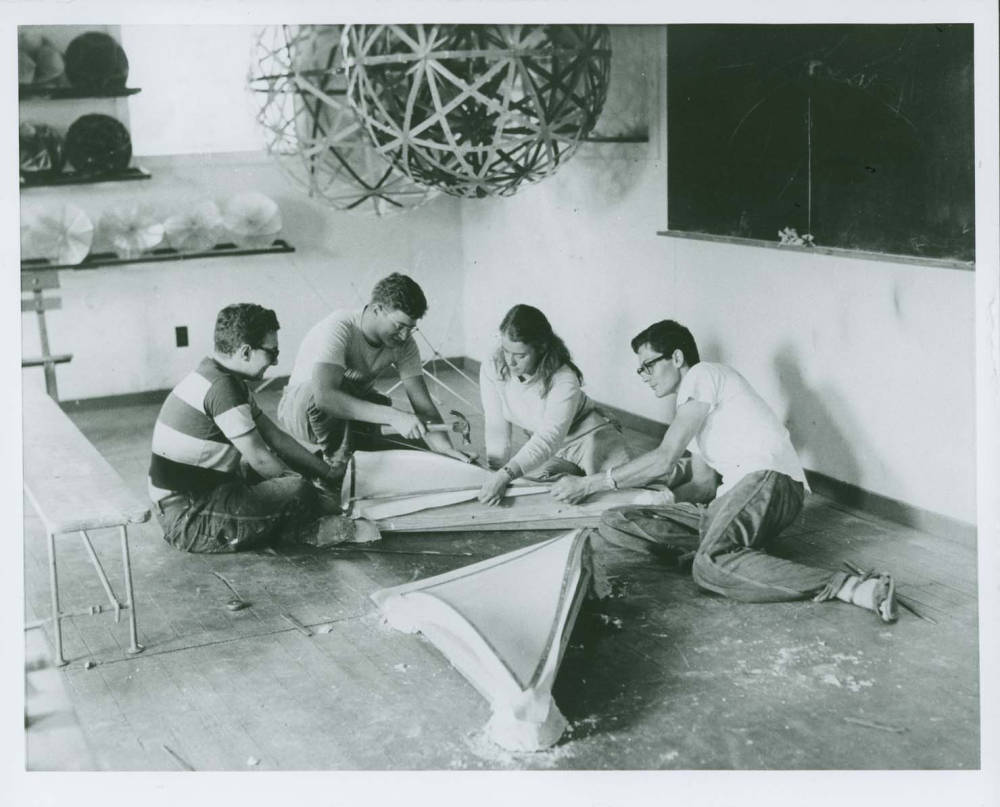
Black Mountain College fue una universidad creada en 1933 en una zona rural de los montes Apalaches, cerca de Ashville, Carolina del Norte. Durante sus veinticuatro años de duración, se erigió como un innovador y experimental centro educativo que hizo de las artes el elemento central de la formación y que situó la creación de una comunidad en el núcleo del proyecto. En este artículo, se analizan los principales elementos que configuraron la filosofía educativa de la escuela y los procesos a través de los que se pusieron en práctica.
- Biografía del autor/a
- Referencias
-
BELLARD, Lauren (2015). The Design-Build Program at Lake Eden," En MOLESWORTH, Helen y ERICKSON, Ruth (eds). Leap before You Look. Black Mountain College, 1933-1957. New Haven/London. Yale University Press/Institute of Contemporary Art, Boston.
DANILOWITZ, Brenda (2006). Teaching Design: A Short History of Josef Albers." En HOROWITZ, Frederick A. y DANILOWITZ, Brenda. Josef Albers: To Open Eyes. The Bauhaus, Black Mountain College and Yale. London/New York. Phaidon, 2006.
DEWEY, John (1976). Experience and Education. New York. Macmillan/Collier Books.
–––––––––––– (2008) El arte como experiencia. Barcelona. Paidós.
DÍAZ, Eva (2015a). The Experimenters. Chance and Design at Black Mountain College. Chicago/London. University of Chicago Press.
––––––––– (2015b). Summer Session 1948. En MOLESWORTH, Helen y ERICKSON, Ruth (eds). Leap before You Look. Black Mountain College, 1933-1957. New Haven/London. Yale University Press/Institute of Contemporary Art, Boston.
DUBERMAN, Martin (2009). Black Mountain College. An Exploration in Community. Evanston, Illinois. Northwestern University Press.
EGGELHÖFER, Fabienne (2015) Processes Instead of Results. En BLUME, Eugen, FELIX, Matilda, KNAPSTEIN, Gabriele and NICHOLS, Catherine (eds). Black Mountain. An Interdisciplinary Experiment, 1933–1957. Berlin. Spector Books.
ELLERT, JoAnn C. (1972). The Bauhaus and Black Mountain College. The Journal of General Education. Vol. 24. Nº 3.
ERICKSON, Ruth (2015) A Progressive Education. En MOLESWORTH, Helen y ERICKSON, Ruth (eds). Leap before You Look. Black Mountain College, 1933-1957. New Haven/London. Yale University Press/Institute of Contemporary Art, Boston.
EZELL, Jason (2011). Martin Duberman’s Queer Historiography and Pedagogy. Black Mountain Sudies Journal. Vol. 11.
FISHER, Jonathan (2014). The Life and Work of an Institution of Progressive Higher Education: Towards a History of Black Mountain College, 1933- 1949. The Journal of Black Mountain College Studies. Vol. 6.
FONTAL DEL JUNCO, Manuel (ed.) (2014). Josef Albers. Medios mínimos, efecto máximo. Madrid. Fundación Juan March.
FÜSSL, Karl?Heinz (2006). Pestalozzi in Dewey’s Realm? Bauhaus Master Josef Albers among the German? Speaking Emigrés’ Colony at Black Mountain College (1933–1949). Paedagogica Historica. International Journal of the History of Education. Vol. 42, Nº1-2. pp. 77-92.
BLAUVELT, Andrew (ed.) (2015). Hippie Modernism. The Struggle for Utopia. Minneapolis. Walker Art Center.
GRANÉS, Carlos (2012). El puño invisible. Arte, revolución y un siglo de cambios culturales. Madrid. Taurus.
HARRIS, Mary Emma (2002). The Arts at Black Mountain College. Chicago. MIT Press.
–––––––––––––––––– (2015). Black Mountain: Was It a Real College or Did We Just Make It up Ourselves? The Journal of Black Mountain College Studies. Vol. 7
HOROWITZ, Frederick A. (2006). Albers the Teacher. En HOROWITZ, Frederick A. y DANILOWITZ, Brenda. Josef Albers: To Open Eyes. The Bauhaus, Black Mountain College and Yale. London/New York. Phaidon.
KATZ, Vincent (ed) (2002). Black Mountain College: una aventura americana. Madrid. Museo Nacional Centro de Arte Reina Sofía.
LEHMANN, Annete Jael (2015). Pedagogical Practices and Models of Creativity at Black Mountain College. En BLUME, Eugen, FELIX, Matilda, KNAPSTEIN, Gabriele and NICHOLS, Catherine (eds). Black Mountain. An Interdisciplinary Experiment, 1933–1957. Berlin. Spector Books.
LEHMANN, Annette Jael y WERNER, Anna (2016). Black Mountain and Beyond – Research Practices between Universities and Museums. Stedelijk Studies. Between the discursive and the Immersive. Curating research in the 21th Century Art Museum. Nº 4.
MOTHES, Kate (2014). Sense of Community. En Black Mountain Research. Collaborative platform by Freie Universität Berlin & Hamburger Bahnhof–Museum Für Gegenwart, Berlin. Disponible en https://black-mountain-research.com/2014/09/30/sense-of-community/
PERROW, Charles (2013). Drinking Deep at Black Mountain College. Southern Cultures. Vol. 19. Nº 4. pp. 76-94.
REESE, William J. (2001). The Origins of Progressive Education. History of Education Quarterly. Vol. 41. Nº 1.
RUIZ, Guillermo (2013). La teoría de la experiencia de John Dewey: significación histórica y vigencia en el debate teórico contemporáneo. Foro de Educación., Vol. 11, Nº15. pp. 113-124.
SILVER, David (2015). Building Autonomy, Creating Community: The Farm and the Work Program at Black Mountain College. En MOLESWORTH, Helen y ERICKSON, Ruth (eds). Leap before You Look. Black Mountain College, 1933-1957. New Haven/London. Yale University Press/Institute of Contemporary Art, Boston.
WEBER, Nicholas F. y BOISSEL, Jessica (eds) (2010). Josef Albers and Wassily Kandinsky: Friends in Exile. A Decade of Correspondence, 1929-1940. Manchester/New York. Hudson Hills Press.
WILKINS, Micah Wilford. (2014) Social Justice at Bmc before the Civil Rights Age: Desegregation, Racial Inclusion, and Racial Equality at BMC. The Journal of Black Mountain College Studies. Vol. 6.
Otras fuentes:
ADAMIC, Louis (Abril, 1936). Education on a Mountain. The Story of Black Mountain College. Harper’s Magazine.
Mary Gregory, Mary “Molly” Gregory Remembers the Work Program. Memoir delivered on the occasion of the opening of a Black Mountain College exhibition, curated by Mary Emma Harris, at Bard College in 1987. Disponible en http://blackmountaincollegeproject.org/MEMOIRS/MEMOIRS.htm
Ruth O’Neill Burnett, The Work Program, in Student experience in experimental education in the early years (1933-43). Section 2: Teachers and Teaching: Outside the Classroom. Black Mountain College Project, curated by Robert Sunley. 1997. Disponible en: https://blackmountaincollegeproject.org/Features/SUNLEY/SUNLEYpartII/OutsidetheClassroomWORK.htm.
A Foreword. Programa de Black Mountain College de 1934-35. Disponible en:
-35 Black Mountain College Catalog. Programa de 1934-1935. Disponible en UNC Ashville. Special Collections and University Archives: https://unca.contentdm.oclc.org/digital/collection/p15733coll6/id/121/rec/2
- Cover Image
-
- Descargas
- Publicado
- 2022-02-08
- Sección
- Dossier
- Licencia
-

Esta obra está bajo una licencia internacional Creative Commons Atribución-NoComercial-CompartirIgual 4.0.

Cómo citar
Artículos similares
- Dulio Oseda Gago, Lesly Elizabeth Torres Chumbiauca, Noemi Mencia-Sánchez, Roger Rivera-Casavilca, Uso de la inteligencia artificial como recurso para potenciar las competencias investigativas y el pensamiento crítico en la educación superior , Encuentros. Revista de Ciencias Humanas, Teoría Social y Pensamiento Crítico.: Núm. 23 (enero-abril) (2025): El arte y el contexto socioeducativo: una relación simbiótica. (Parte 2)
- Srbaz Nidham Othman, Aqeel Mahmood Jawad, Raed Hameed, Raad Tomaa Kawad, Dmytro Khlaponin, The impact of cybersecurity law in the middle east , Encuentros. Revista de Ciencias Humanas, Teoría Social y Pensamiento Crítico.: Núm. 23 (enero-abril) (2025): El arte y el contexto socioeducativo: una relación simbiótica. (Parte 2)
- Laura de Miguel Álvarez, Una experiencia a/r/tográfica con su contribución metodológica: Unnoticed en Fort Breendonk , Encuentros. Revista de Ciencias Humanas, Teoría Social y Pensamiento Crítico.: Núm. 23 (enero-abril) (2025): El arte y el contexto socioeducativo: una relación simbiótica. (Parte 2)
- Fiorella Nesta, Remember It. Testimoniar las dictaduras en el siglo XXI. Politicas de los traumas psicosociales en America Latina , Encuentros. Revista de Ciencias Humanas, Teoría Social y Pensamiento Crítico.: Núm. 26 (enero-abril) (2026): Fronteras epistémicas y prácticas entre el pensamiento crítico y la realidad social.
- Adhraa Oudha Hussen Al-Saedi, Ayat Mothafer Al-Turath , Ahmed Taher Kadhim, Dmytro Khlaponin, The intersection of public administration and criminal justice: administrative criminology in action , Encuentros. Revista de Ciencias Humanas, Teoría Social y Pensamiento Crítico.: Núm. 23 (enero-abril) (2025): El arte y el contexto socioeducativo: una relación simbiótica. (Parte 2)
- Victoriano Camas Baena , Función social de la vinculación con la sociedad en el Sistema de Educación Superior de Ecuador. , Encuentros. Revista de Ciencias Humanas, Teoría Social y Pensamiento Crítico.: Núm. Extra (2022): Edición 10° aniversario: Conocimiento y desarrollo: vinculación universitaria y cambio social en América Latina.
- Pedro Luis Bracho Fuenmayor, Criminalización de la comunidad queer. Un estudio comparado con visión latinoamericana. , Encuentros. Revista de Ciencias Humanas, Teoría Social y Pensamiento Crítico.: Núm. 18 (mayo-agosto) (2023): Criminología, ciencia penal y prevención.
- Esther Carmona-Pastor, Sofía Marín-Cepeda, La memoria en extinción: Proyecto para la recuperación del patrimonio inmaterial en peligro de olvido. Arte, memoria y educación , Encuentros. Revista de Ciencias Humanas, Teoría Social y Pensamiento Crítico.: Núm. 23 (enero-abril) (2025): El arte y el contexto socioeducativo: una relación simbiótica. (Parte 2)
- Bushra Abd Al-Lattif, Alaa Shawkat Ibraheem, Shaker Jameel Sachet, Alla Hotsalyuk, Young people involved in criminal justice are associated with housing instability , Encuentros. Revista de Ciencias Humanas, Teoría Social y Pensamiento Crítico.: Núm. 23 (enero-abril) (2025): El arte y el contexto socioeducativo: una relación simbiótica. (Parte 2)
- Manuel Sánchez-Chero, Jessie Bravo, Nilton Cesar Ayra Apac, Omar Luis Carbajal García, Inteligencia artificial una irrupción fenomenológica en la educación. Oportunidades y amenazas , Encuentros. Revista de Ciencias Humanas, Teoría Social y Pensamiento Crítico.: Núm. 22 (septiembre-diciembre) (2024): El arte y el contexto socioeducativo: una relación simbiótica (Parte 1).
También puede Iniciar una búsqueda de similitud avanzada para este artículo.